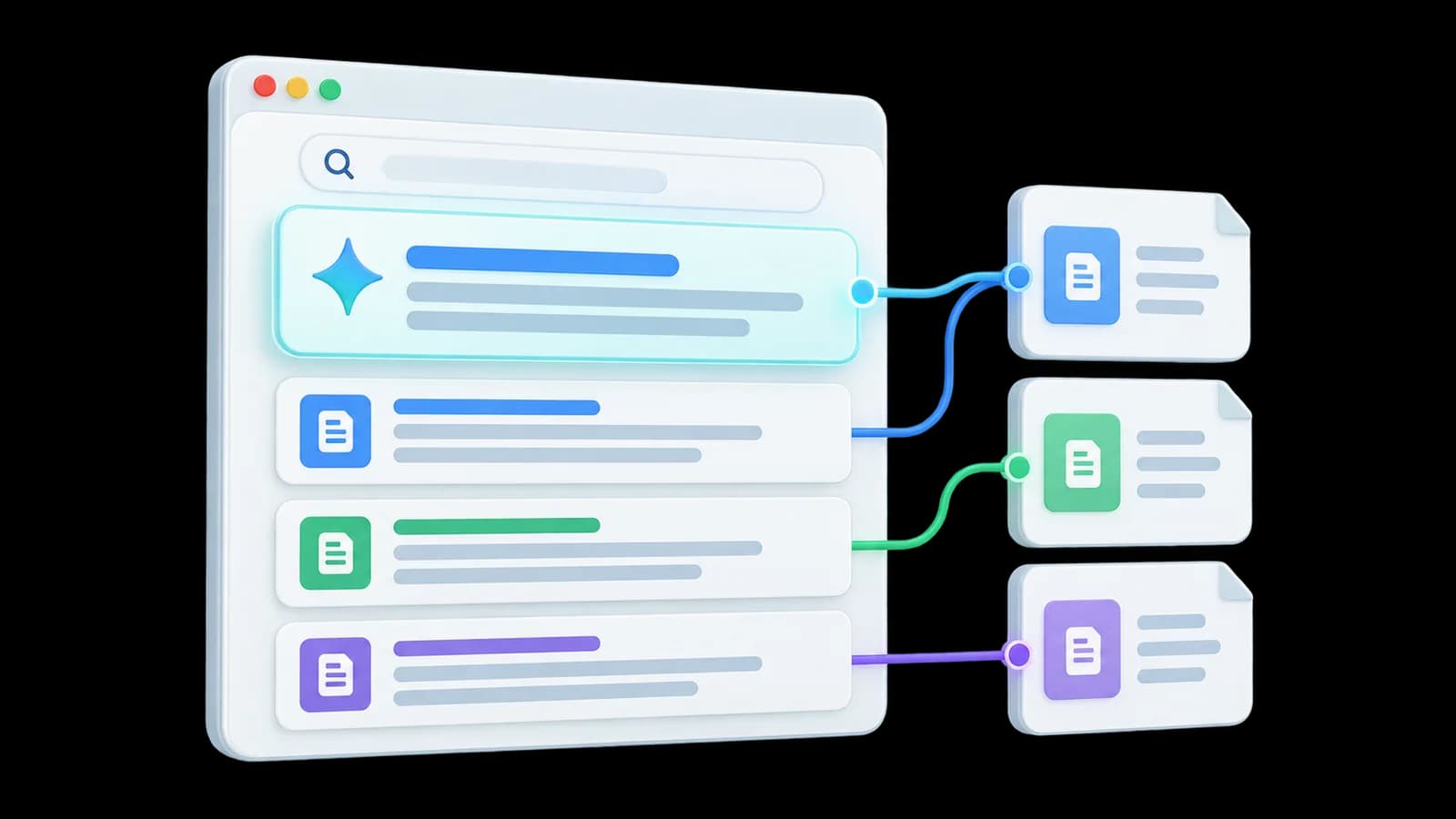
The Google AI Overview feature will organize information and provide supporting links in certain searches. AI Mode is better suited for more complex exploration, comparison, and in-depth research. The platform does not have a dedicated submission form or specific schema; pages must first meet the general technical and content requirements of Google Search. Instead of guessing how each page will change, it's more practical to ensure that the content is indexable, has value, and that search and conversion results can be tracked.
AI Overview and AI Mode: How to use them on the webpage?
Google's official explanation states that these two features may use "query fan-out," breaking down a complex question into multiple related searches and finding relevant support pages. Because different features may use different models and methods, the displayed answers and links will vary. The "AI Overview" feature only appears when the system determines that it can add value to a general search, and it is not triggered by every query. This also means that a single "target keyword" is not sufficient to cover the subtopics that users may explore.
What are the basic requirements for a website?
To become a supported link for "AI Overview" or "AI Mode," the page must be indexed by Google, display a summary in Google Search, and comply with Google's search technology and policy requirements. Google does not have any additional requirements for AI technology and does not require the addition of new AI text files or a dedicated schema. However, meeting these requirements does not guarantee that the page will be crawled, indexed, or displayed by Google, as Google's results are determined by its query and quality systems.
robots.txt, CDN, and WAF allow Googlebot to crawl
The page should be indexable, have a correct canonical URL, and display a search summary.
Key information is presented in text format and can be accessed through links within the site.
The structured data aligns with the content that users can see and understand.
The page design, images, and videos genuinely aid in understanding when appropriate.
What factors increase the chances of your content being selected as a source?
Google does not publish a fixed citation formula, but the principle of human-centered content still applies: directly answering questions, providing project experience, citing original sources, and clearly indicating the author and any limitations. Tables and lists can improve understanding, but they are not special ranking signals. The real difference lies in whether the information is more specific and easier to verify than existing results. If an article simply restates existing definitions, even if it is lengthy, it does not add any new value.
Common reasons for failure
The following issues simultaneously reduce the usability of both general search and AI-powered search:
Pure marketing jargon (lacking verifiable information)
The key is buried very deep (it needs to be slid all the way to the bottom to appear).
Content that requires JavaScript to be rendered
Repeating basic internet knowledge without firsthand experience or unique value.
How much AI-related data can I see in Search Console?
Google has launched a standalone Generative AI performance report for Search Console, which displays website visibility and presentation in AI Overviews and AI Mode, including metrics such as page views, countries, devices, and dates. This report is currently available to a limited number of websites and does not provide data on clicks, CTR, or average ranking. The relevant exposure data is still included in the standard Web Performance report. If you haven't seen the dedicated report, you should not use third-party sampling to estimate Google's overall platform exposure based on trends in non-branded searches and landing page performance in Web Performance, combined with GA4 conversion data.
Division of labor after publication
Source of information
Suitable for answering
It cannot be proven in isolation.
Generative AI reports
AI features revealed, display pages, country, device, and date.
Queries, clicks, CTR (click-through rate), ranking, or websites that are not yet open.
Do users read the case studies, click on the call-to-action buttons, or inquire after arriving at the station?
Mentions of brands without any clicks
Practice Problems
Does the specific problem originate from the description of the product or brand?
Overall market visibility or fixed ranking
Do not draw conclusions based on limited or unreliable data.
AI Overview may allow some users to directly obtain answers, or it may provide new support links for complex issues. The results from a single website are affected by the query combination, brand, layout, competition, and time, and cannot be directly stated that traffic will definitely decrease or that "getting clicks through citations will guarantee results" without having its own Search Console and conversion data. The correct approach is to establish benchmarks based on page-specific and non-branded queries, and then observe the trends after the changes.
It's important not to make generalizations. Different searches and websites may yield different results; instead, use your own Search Console data for clicks, impressions, and click-through rates, and compare them to your own inquiry benchmarks, rather than relying on average figures or guarantees from third-party sources.
AI Overview: When will AI appear in search results?
According to Google's search query analysis, the results are only displayed when the system determines that they add value to the search. The website cannot proactively trigger these results. Therefore, when analyzing trends, it's important to look at the overall trend rather than just taking a single snapshot, as the same query may yield different results at different times and in different locations.
Should I create a separate version of the AI Overview content?
No. The links for the AI Overview come from a general search index, and the page must meet the general search criteria. Maintaining two separate sets of content is much more practical than having one page with both the question and the answer.