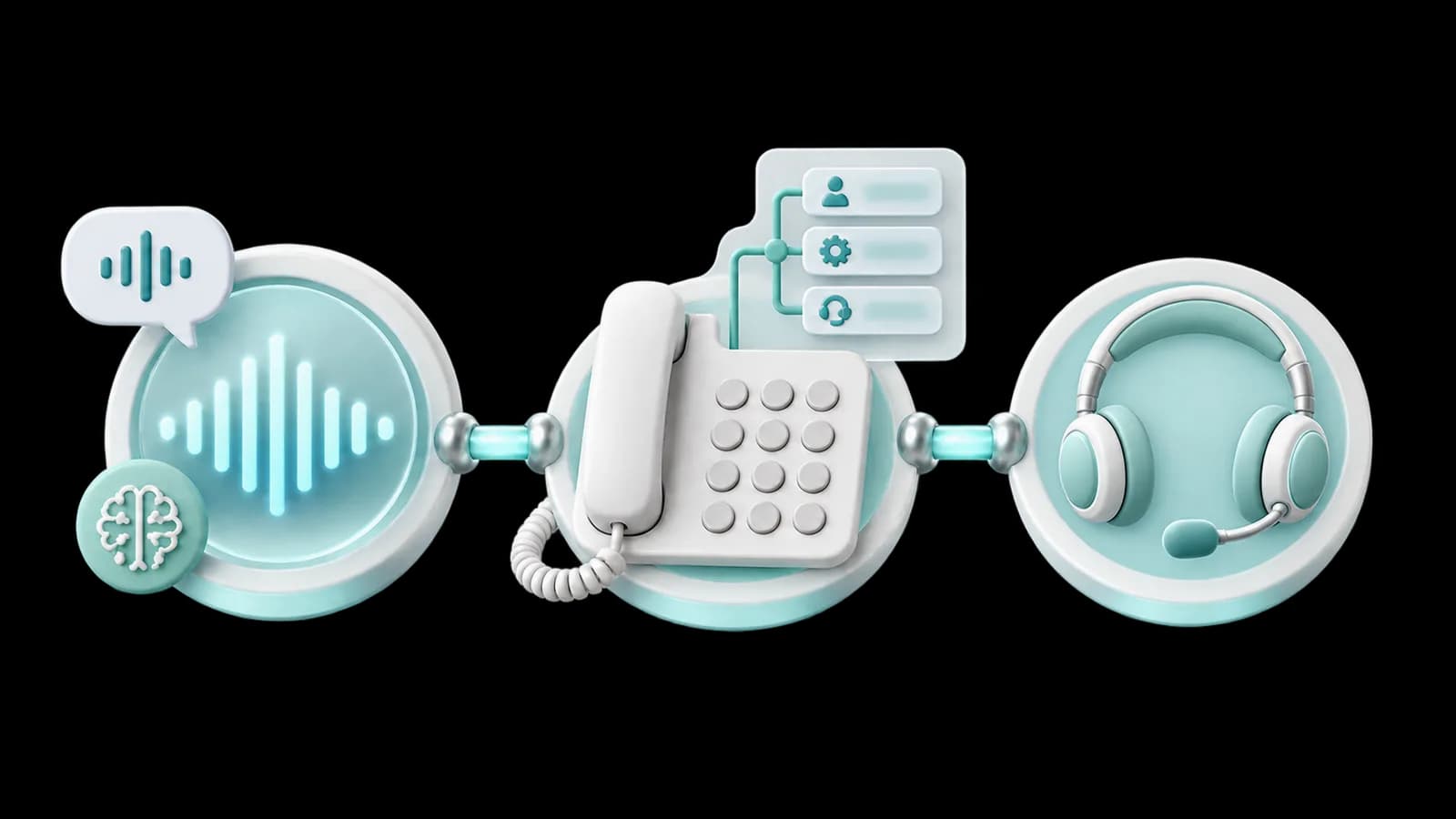
AI-powered voice assistants, traditional IVR systems, and human customer service: a comparison
AI voice-based customer service, traditional IVR, and human agents are not mutually exclusive. Simple, low-risk tasks with limited branching can be handled by IVR; tasks requiring natural language understanding and repetitive system operation can be handled by AI; and human agents remain the primary option for tasks involving emotions, exceptions, significant stakes, or irreversible decisions. Most companies are better suited to a hybrid approach.
IVR uses key presses or pre-recorded voice menus to route calls, making the rules clear, the results predictable, and the system risks easily manageable. It is suitable for short processes such as call routing, department selection, and entering fixed codes. However, the drawback is that with many branches, it can become difficult to navigate, and users may still need to be transferred to a human operator if they don't know which option to choose. Don't replace existing, reliable IVR systems with AI just because it's new.
What types of customer service inquiries are well-suited for AI voice assistants?
The advantages of AI include its ability to understand more natural language, ask clarifying questions when information is missing, and translate results into actions within an enterprise system. It is well-suited for collecting repetitive but varied data, creating cases, querying status, and assigning tasks. However, its limitations include the potential for misinterpretation by both speech recognition and the model. Therefore, it is essential to use field verification, backend rules, and human intervention to limit errors to a manageable level.
Which jobs should still be performed by humans?
Significant customer complaints, emotional support, contract and legal disputes, medical assessments, payment authorization, identification of anomalies, and cross-departmental exception handling all require understanding the context, taking responsibility, and exercising flexible judgment. While AI can organize existing data, search for records, or create to-do lists, it should not pretend to have complete decision-making authority.
In practice, a hybrid architecture is more stable.
A common division of labor is not "AI replacing humans," but rather assigning each layer to handle the aspects it is best suited for:
IVR: Handles the most common routing, identity verification, and required disclosures.
AI: Capable of processing natural language, asking clarifying questions, organizing data, and performing low-risk system actions.
Real-life scenarios: Handling exceptions, sensitive decisions, customer complaints, and conversations with individuals who lack confidence.
Backend: Standardized authentication, data format, retry mechanisms, status management, and auditing.
Choose between IVR, AI, human agents, or a hybrid approach based on the specific requirements of the task.
Assessment direction
IVR
AI voice customer service
Live customer service
Input method
Buttons or fixed options
Natural language and multi-turn questioning
Natural language understanding and flexible reasoning
Suitable for the task
Extension, number, short-range call routing
Data collection, searching, and operation of low-risk systems
Customer complaints, exceptions, sensitive or high-stakes decisions
Key Risks
The menu is too deep, and I can't find the option I'm looking for.
Identifying and correcting misclassifications and errors in models
Waiting time, human resources capacity, and consistency
Essential safety net
The ability to switch personnel at any time.
Field verification, backend validation, and handling low confidence scenarios.
Knowledge, skills, records, and management support
What questions should be answered before choosing a business?
If you are unable to answer the following questions, please refrain from selecting a supplier or model just yet:
What is the most common task that callers are typically asked to complete?
Which fields are incorrect and can be corrected, and which fields are absolutely essential to be correct?
What is the maximum time allowed for multiple openings and acceptance of applications?
Which enterprise systems and permissions does the AI need to access?
When transitioning between different roles or projects, what context information should be provided?
What is the GoGoCha business model?
GoGoCha's key focus in its public implementation is to integrate car-hailing requests from phone, website, and LINE into a shared backend, rather than simply creating a voice-based chat interface. This architecture retains human intervention, utilizing the app, backend, and real-time notifications to manage task status, aligning with the hybrid approach of "AI handles repetitive entries, backend controls tasks, and humans handle exceptions."
In what situations would it be more reasonable to implement only IVR or only add human agents?
If the primary need is simply to route calls by department, input fixed numbers, or play pre-recorded messages, then IVR systems are often more cost-effective and predictable. If call volume is low but each call involves complex customer complaints, negotiations, or professional judgment, then improving the human agent experience, knowledge base, and CRM interface may be more effective. The value of AI should come from automating repetitive tasks and integrating with existing systems, rather than simply appearing in purchasing presentations.
Frequently Asked Questions
Is AI always better than IVR?
Not necessarily. Fixed routing systems using IVR are typically simpler and more controllable. AI only offers significant value when dealing with natural language and multi-turn questioning.
Are customer service agents still needed after implementing AI?
Typically, this role involves handling routine tasks, but with a focus on resolving exceptions, sensitive issues, and high-value conversations. The handover process should be completed and verified before taking over the role.
Can I use both my existing IVR and AI systems simultaneously?
Yes, and this is often the most reliable approach: IVR retains legal disclosures and fixed routing, while AI handles natural language processing tasks, both utilizing the same backend and human agent resources. There's no need to replace the entire IVR system just to introduce AI.
Let's start by discussing current call handling methods, system actions after a call, and exception handling. After outlining the requirements, we can then confirm the demo time, the scope of the demonstration, and whether a Proof of Concept (POC) is needed.