How can AI-powered phone systems integrate with PBX, CRM, ticketing, and dispatch systems?
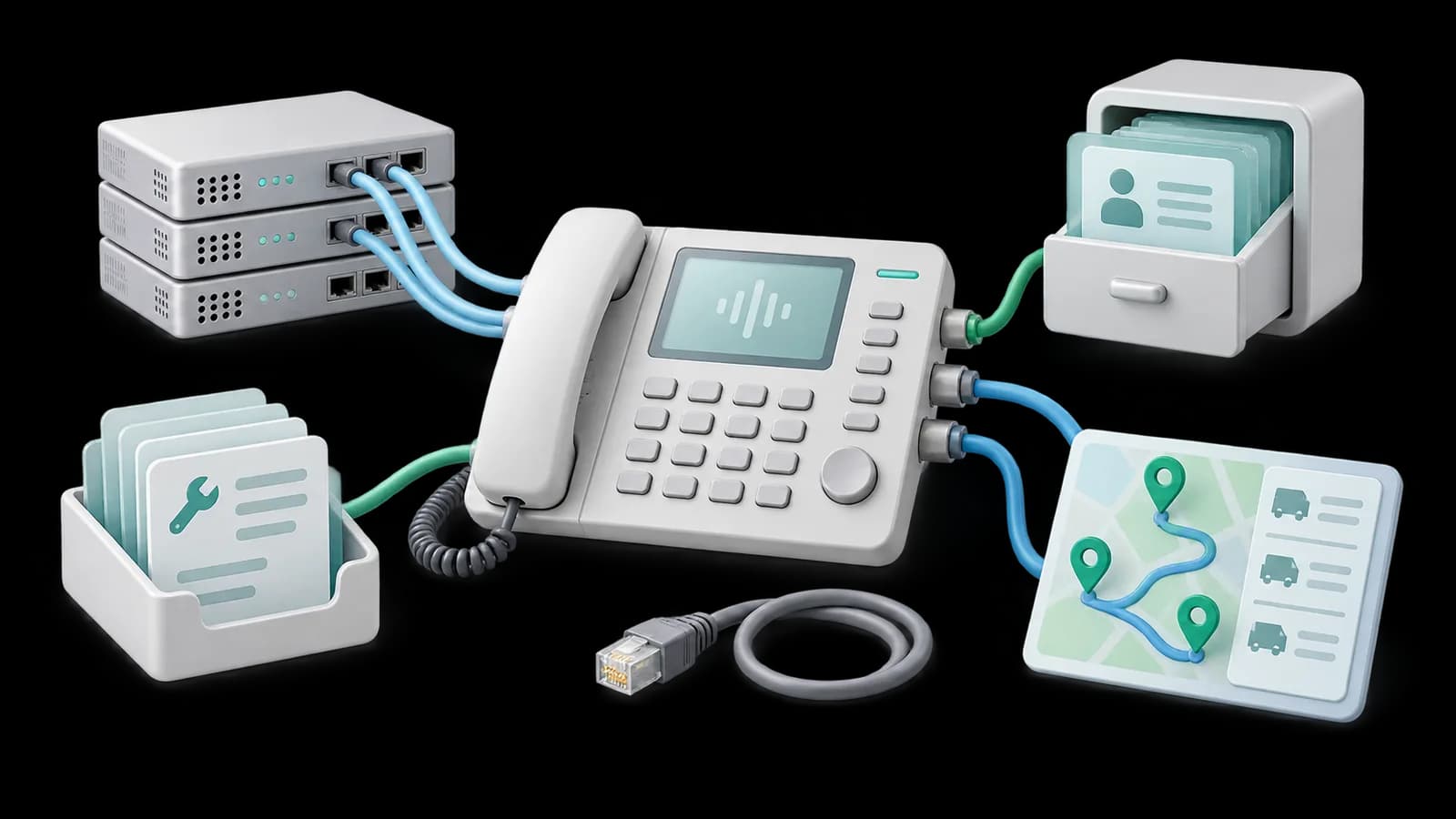
AI phone integration is not simply a matter of using a single API. The telephony layer handles number, routing, and call forwarding; the dialogue layer converts speech into structured data fields; the workflow layer verifies permissions, rules, and status; and finally, CRM, ticketing, scheduling, or dispatch systems are responsible for the actual business actions. If these four layers are not clearly separated, a failure in any one layer could lead to duplicate orders or incorrect commitments.
What are the roles of PBX, SIP, and AI respectively?
PBX management includes call distribution, routing, and call queuing/transferring; SIP is a common voice communication protocol; and AI handles recognition, understanding, and response. Whether a company can continue using existing phone numbers depends on the telecommunications provider, the PBX's capabilities, and existing contracts. AI vendors cannot simply state that they "support SIP" and assume that all requirements for numbers, recordings, transfers, and concurrent calls are already met.
The conversation content needs to be converted into a data agreement first.
Corporate systems should not directly receive complete natural language sentences, but rather define the necessary fields, formats, sources, confirmation status, and unique request identifiers. For example, a repair order might require fields such as equipment, address, contact information, service hours, and problem category. AI can only suggest potential values, but these values must be confirmed and validated by the user and the backend system before being executed.
What should be checked in the CRM, work order, and dispatch API?
Before connecting, please ensure the following interface conditions are met:
Are there any official APIs, a testing environment, and a permission model?
Responsibilities for establishing, querying, updating, and canceling
How to avoid duplicate case creation from the same call
Is it possible to inquire about the final status when a request is overdue?
Can an event or webhook be used to retrieve the subsequent status?
When the API request times out, the AI cannot initially report a successful response.
While a delayed response online doesn't necessarily mean a task has failed, nor does it guarantee success. The system should use unique identification, idempotent processing, a retry queue, and status queries to prevent duplicate orders. If the result cannot be confirmed during the call, it should clearly inform the user that the request has been transferred to a pending status and establish a manual follow-up or subsequent notification, rather than simply responding with "completed" to maintain a smooth conversation.
What contextual information needs to be manually transferred?
The transcript should at least include fields for call source, confirmed information, unresolved issues, conversation summary, system query results, and reasons for failure. Whether the original recording or transcript is provided to the assigned representative depends on the notification, authorization, and retention policies. If only the call is transferred without any context, the user will still need to repeat the entire conversation, which would diminish the value of automation.
How should a POC (Proof of Concept) be validated?
Choose a specific business task and test it in a realistic phone environment using API validation. Verify that the process works smoothly, that there is sufficient data, that there are no identification errors, that duplicate requests are handled correctly, that API timeouts are handled properly, that the enterprise system rejects invalid requests, that users are correctly identified, and that manual intervention is handled appropriately. The results of the testing should allow you to track each step of the process from the backend, rather than just listening to a pre-recorded ideal conversation.
Key integration points for GoGoCha
GoGoCha utilizes a modular architecture based on Express, PostgreSQL, Redis, BullMQ, and Socket.IO to integrate phone calls, websites, and LINE into a single dispatch workflow. The database stores task status, while the queue handles asynchronous tasks, and real-time communication synchronizes data to the app and operational interface. This case demonstrates that cross-channel workflows don't necessarily translate directly to all businesses using PBX systems.
Frequently Asked Questions
Can older systems without APIs still be integrated?
Each system should be evaluated individually. It may be necessary to first implement APIs or intermediary layers for older systems; direct manipulation of the user interface through automation is inherently less reliable and should not be treated as equivalent to a formal API.
Does establishing a SIP connection automatically mean that an AI-powered telephone system is complete?
No. SIP only handles a portion of the voice transmission, and further steps are still required, including dialogue, data verification, actions within enterprise systems, monitoring, fallback procedures, and manual intervention.
Which system permissions should be granted to the developer during the integration process?
The principle is to apply the principle of least privilege: test environments should have full administrator access, while production environments should only have access to the necessary API ranges, and all actions should be logged for auditing purposes. If a client requests full administrator access before starting work, this should be treated as a warning sign and clarified before proceeding.
Let's start by discussing current call handling methods, system actions after a call, and exception handling. After outlining the requirements, we can then confirm the demo time, the scope of the demonstration, and whether a Proof of Concept (POC) is needed.