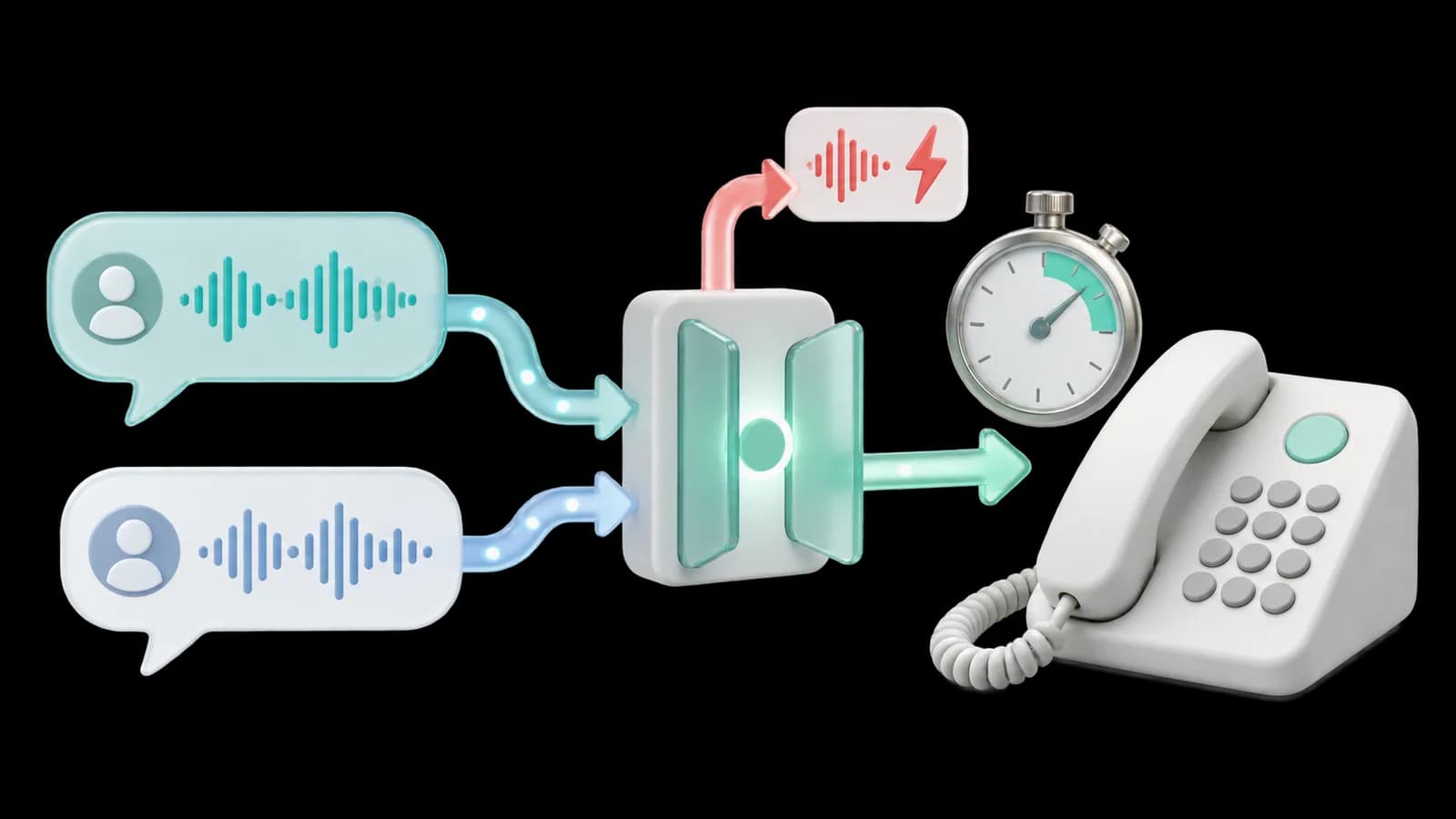
Where does the waiting time for an AI phone call come from?
After the call passes through the telecommunications and SIP/PBX routing, the audio is processed, and the system determines whether the user has finished speaking, it then uses a model to understand the call and initiate a request to the enterprise tool. Finally, the response is converted back into audio and sent back to the phone. If querying a CRM or creating a ticket requires waiting, the perceived latency will also be affected. Only measuring the initial token of the model will ignore the entire path that the caller actually experiences.
End-to-end latency analysis for AI-powered voice customer service| Stage | Measurement start and end | Common Risks |
|---|
| Telephone transmission | Incoming and outgoing audio communication platform | Electrical routing, encoding/decoding, network jitter, and packet loss |
| Boundary identification | The system will stop processing once the user has finished speaking. | Waiting too long or cutting it off prematurely |
| Sample Response | Submit valid input to generate playable content. | Long context, model selection, and complex reasoning. |
| Call for tools | Send an API request to retrieve available results. | Enterprise System Timeout, Retry, and Queuing |
| Audio playback | The text or audio begins to play on the phone. | Synthetic buffering, initial package waiting, and playback cancellation |
VAD addresses the question of "whether someone is speaking," while contour detection focuses on "whether the speech is complete."
Server-side VADs typically determine the start and stop of speech based on volume and silence duration. Semantic VADs go further by estimating whether the meaning is still in progress. Longer waiting times reduce the risk of cutting off speech, but also increase the duration of pauses. If the VAD reacts too quickly, it may cut off phrases like "um... I want to change that" into two separate segments. The parameters cannot be universally applied; names, addresses, codes, and open-ended descriptions require different levels of tolerance for pauses.
"Barge-in" refers to interrupting a conversation, and it does not necessarily mean that the conversation is over.
"Barge-in" allows the caller to interrupt the AI during playback and stop the original response, which is useful for correcting information, skipping known content, and shortening menus. However, "Barge-in" and the system's silent judgment of the user having finished speaking are two separate things. Generally, interruptions should be allowed during normal conversations; however, recording prompts, necessary disclosures, or important field confirmations should be handled according to individual company processes and legal requirements. Turning "Barge-in" off globally will make conversations feel unnatural, while turning it on globally could prevent important content from being played.
Don't just report the average latency; also look at the p50, p95, and error rates.
The average value can be easily skewed by a small number of very slow or very fast samples. The p50 value represents the typical response time, while the p95 value represents the worst-case scenario that is still commonly encountered. Additionally, the data records the time it takes for a user to stop speaking and receive the first response, the time it takes for the tool to complete, the occurrence of errors, the time spent waiting for errors, and the failure of interruptions. Each sample must also be labeled with the task, network, language, and whether an API call was made to the company. Without this information, it is difficult to pinpoint the cause of the problem when different scenarios are mixed together.
The delay and rotation should be recorded together.| Observation project | Definition of an event | Determining the purpose |
|---|
| Initial response delay | Confirm that the process has ended when the user hears a response. | Differentiating between sequential, model-based, and synthetic waiting |
| Tool is waiting. | The API has successfully retrieved the data and it is now available for use. | Identify bottlenecks in corporate systems or third-party services. |
| Truncated error | The user started responding before they had finished speaking. | Adjust VAD, row, and column strategies. |
| Error waiting | The user has finished speaking, but the system remains silent. | Check completion status, timeout, and tool status |
| The comment was successfully posted. | Once a user makes a comment, the original response is stopped, and the new input is retained. | Verify that the playback is consistent with the context. |
The real-world phone test should include elements such as background noise, echo, accents, and long pauses.
The microphone on a webpage, when tested in a quiet office setting, cannot be assumed to function correctly on mobile phones, in cars, with hands-free devices, Bluetooth headsets, or landlines. The test should cover a range of scenarios, including background noise, echo, signal instability, varying speech speeds, common accents, numbers, alphanumeric codes, and long addresses. The goal for critical fields is not just to ensure accurate transcription, but also to ensure that the system can re-transcribe, allow the user to correct errors, and stop processing if the accuracy is uncertain.
When a tool call goes unanswered for a long time, avoid filling the silence with false assurances.
CRM, ERP, or dispatch API requests may take several seconds or even initiate asynchronous processes. While the system can use brief status updates to avoid a completely silent experience, it cannot say "completed" before the results are returned. When the expected conversation time is exceeded, it should transition to a "pending confirmation" or "manual processing" status, and use a unique identifier to prevent redundant execution. If optimizing for speed sacrifices the accuracy of the results, it simply makes the error more obvious.
"3 seconds" can only be a design goal, not a Service Level Agreement (SLA) that GoGoCha publicly commits to.
GoGoCha's publicly available case studies demonstrate the effectiveness of the phone-based entry and real-time dispatch workflow, but they do not provide publicly available data on end-to-end latency distribution, telecommunications environment, call samples, or Service Level Agreements (SLAs). Product design goals should not be written as achieved service levels without the same event definition and real measurements. Companies should re-establish p50, p95, and failure sample data within their own PBX/SIP, API, and peak conditions.